
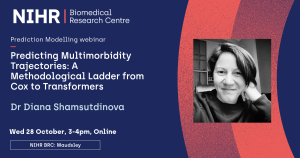
Prediction Modelling Presentation: Dr Diana Shamsutdinova
Speaker Biography
Dr Diana Shamsutdinova is a Research Fellow in the Department of Biostatistics and Health Informatics at the IoPPN, King’s College London. She holds a PhD in Biostatistics from KCL, an MSc in Neuroscience and Psychology of Mental Health, and a mathematics degree from Moscow State University.
Her methodological research focuses on longitudinal prediction, survival models, multi-outcome and foundation models, and the application of AI and machine learning to clinical data. Her clinical interests lie in the shared underpinnings of mental and physical health outcomes, including diabetes and psychosis, cardiovascular disease and depression, together with the social and environmental factors that connect them.
Abstract for the Presentation
Most people with a chronic condition in fact manage more than one. In England, over 40% of people aged 50 and above live with three or more chronic diseases, which makes multimorbidity prediction a pressing challenge for precision medicine. Published models, however, are either single-outcome specialist models or large foundation models, whose benefits for downstream prediction remain limited and mixed.
In this work, we take single-outcome Cox models as the baseline and then investigate how progressively more complex longitudinal models predict several outcomes simultaneously, and whether their increasing flexibility and computational cost translates into gains in predictive accuracy. Simulated clinical histories, with varying degrees of cross-feature and inter-temporal dependence, let us test models of matching complexity in a controlled setting. We also applied the models to real-world data.
We found that deep learning multi-outcome longitudinal models, namely time-series architectures and transformers, offer specific advantages for multimorbidity prediction, and we propose validation metrics that articulate those gains. We also showed that data with low underlying complexity may not benefit from such models.
Please contact maudsley.brc@kcl.ac.uk if you have any questions.
Prediction Modelling Presentations
The Prediction Modelling Group at the NIHR BRC: Maudsley hosts monthly online presentations on Machine Learning and Prediction Modelling and their applications to solve healthcare problems. Speakers from the UK and abroad present their works on developing and/or using machine learning and prediction modelling methods to answer questions as how to choose the best treatment for a patient or how to improve the diagnosis of a disease. Find out more: www.maudsleybrc.nihr.ac.uk/facilities/prediction-modelling-group/