

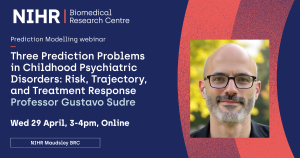
Prediction Modelling Presentation: Professor Gustavo Sudre
Speaker Biography
Gustavo Sudre is the Rosetrees Pears Chair of Bioinformatics and Professor of Genomic Neuroimaging and Artificial Intelligence at the Institute of Psychiatry, Psychology & Neuroscience, King’s College London.
He leads the OPM-MEG programme at the Pears Maudsley Centre and co-leads the Precision Psychiatry and AI for NeuroDevelopmental Analysis (PANDA) Lab.
He is an affiliate of King’s Institute for Artificial Intelligence and holds a PhD in Neural Computation and Machine Learning from Carnegie Mellon University.
Before joining King’s in 2024, he spent over a decade at the National Human Genome Research Institute, most recently as Associate Investigator, developing computational approaches that integrate neuroimaging and genomic data to understand ADHD and related neurodevelopmental disorders. His work has appeared in PNAS, JAMA Psychiatry, Biological Psychiatry, Molecular Psychiatry, and Neuropsychopharmacology.
His lab combines discovery science with clinical prediction, with the goal of building models that are translatable to practice in child and adolescent psychiatry.
Abstract for the presentation
Child and adolescent mental health is among the most pressing challenges in medicine, and among the hardest settings in which to build reliable prediction models. Small samples, developmental heterogeneity, comorbidity, and the underrepresentation of severely affected and demographically diverse children all work against generalizability.
Professor Sudre’s lab at King’s is organized around three prediction problems in this setting: who is at risk, how symptoms will unfold, and which treatment will help.
- The first is risk prediction, anchored in a recently funded Wellcome project that aims to predict OCD risk across multiple time points using longitudinal neuroimaging, genomic, and cognitive data.
- The second is trajectory prediction, building on our earlier work that predicted the course of ADHD symptoms from childhood features, which we are now positioned to extend and test across cohorts assembled since.
- The third is treatment-response prediction, where we are transitioning from supervised biotyping toward unsupervised approaches that may stratify children into subgroups relevant to intervention choice. Alongside these are discovery pipelines in genomics and postmortem neuroscience, including recent findings on cortical glutamate levels and the cortico-striatal transcriptome in ADHD, which we see as candidate mechanisms for future predictive models.
He will discuss methodological choices that shape whether a psychiatric prediction model is useful in practice, from cohort harmonization to validation strategy, and introduce the Pears Maudsley Centre as a new facility built to address these data problems directly and serve as a hub where researchers and clinicians can deeply phenotype children together.
Please contact maudsley.brc@kcl.ac.uk if you have any questions.
Prediction Modelling Presentations
The Prediction Modelling Group at the NIHR Maudsley BRC hosts monthly online presentations on Machine Learning and Prediction Modelling and their applications to solve healthcare problems. Speakers from the UK and abroad present their works on developing and/or using machine learning and prediction modelling methods to answer questions as how to choose the best treatment for a patient or how to improve the diagnosis of a disease. Find out more: www.maudsleybrc.nihr.ac.uk/facilities/prediction-modelling-group/