
Treatment-resistant depression (TRD) is a form of depression where patients do not respond to two or more treatments. It affects approximately 20–50% of individuals with major depressive disorder, leading to significant disability and increased healthcare costs.
Augmentation is an approach where patients who are currently on a medication are given an additional medication at the same time. Currently a large proportion of individuals with TRD are untreated in primary care and find it hard to access augmentation treatments in secondary care.
“Treatment-resistant depression is a common, potentially severe and life-changing illness that, by its nature, is difficult to treat with the medications we currently have available.” – Professor Anthony Cleare, King’s College London
Previous research has identified several candidate medications for an augmentation approach, and the choice may depend on patients’ depressive symptoms and clinical presentation.
Amongst these are antipsychotics such as quetiapine and mood stabilisers such as lithium, both of which are first choice options for management of TRD with augmentation in the Maudsley Prescribing Guidelines (Taylor et al 2021). Quetiapine is also the only atypical antipsychotic with a UK licence in treatment-resistant depression, and its short-term efficacy versus lithium is established. However, few studies have compared them directly, and none for longer than 8 weeks.
How are we meeting this challenge?
To address this and explore the best solution, our BRC led a collaboration with several NHS Trusts to conduct a 12-month trial where participants were allocated to receive augmentation with either lithium or quetiapine to compare the clinical- and cost-effectiveness of both.
Our Centre led a collaboration with multiple NHS Trusts across England to conduct the Lithium versus Quetiapine in Depression (LQD) study, a pragmatic, open-label, randomised controlled trial. The Chief investigator of the LQD Study, Professor Cleare, is a PI funded by the NIHR Maudsley BRC.
People with lived experience were involved in designing (providing feedback on the protocol and patient-facing documents) and running the trial (providing feedback on recruitment methods and participating as members of the trial steering committee).
The study found that quetiapine augmentation resulted in a greater reduction in depressive symptoms and was more cost-effective than lithium. Alongside this, qualitative interviews with patients indicated a positive experience of augmentation treatment. These findings suggest that quetiapine augmentation improve patient outcomes and reduce healthcare costs.
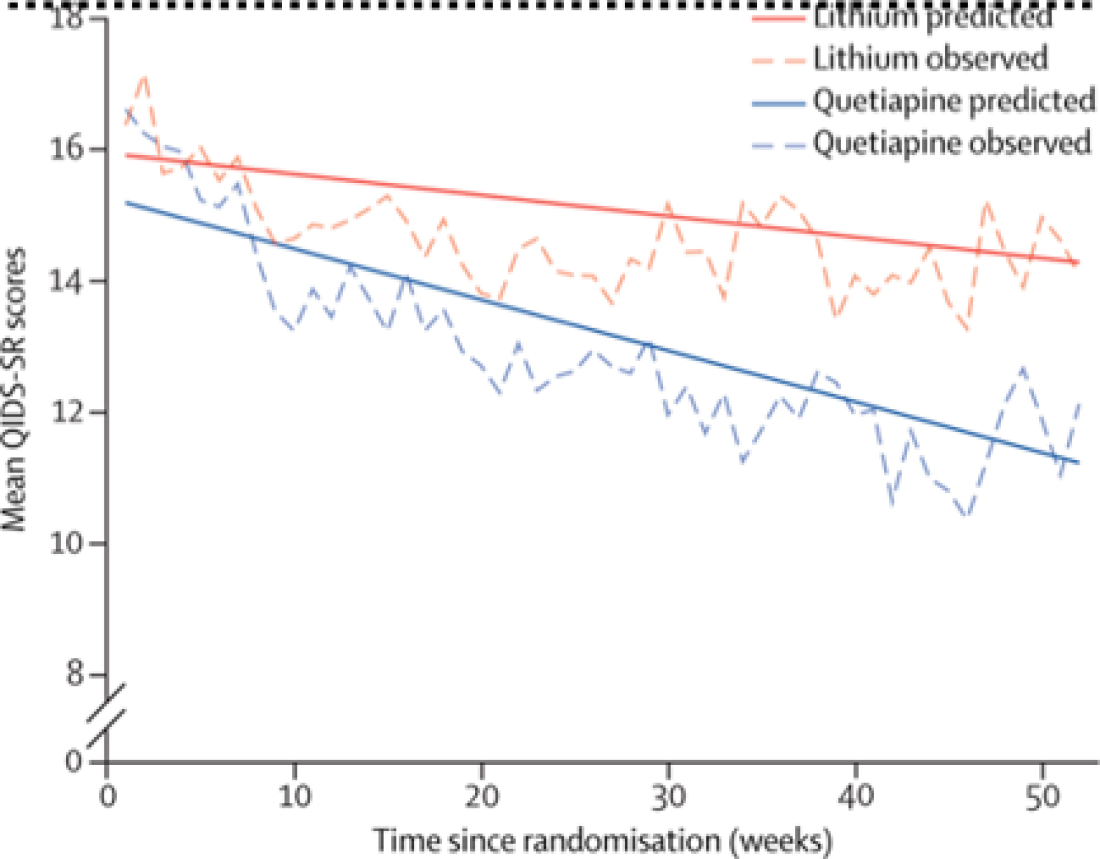
Observed and predicted weekly QIDS-SR scores in the intention-to-treat population
The findings have clear implications for NHS treatment recommendations, suggesting that quetiapine could be a preferred augmentation strategy for managing TRD, improving symptom management and quality of life. Healthcare providers would have a viable evidence-based option to aid clinical decision-making. Alongside this, NHS and Social Care Systems could benefit from more cost-effective treatment options, leading to potential resource savings.
“This study is the first to directly compare quetiapine with lithium over an extended period of time and provides a robust argument for quetiapine’s use. Despite the effectiveness of augmentation treatments, very few patients with treatment resistant depression actually receive them (less than 2% according to one recent study of UK GPs). Improved education, training and support is needed to improve access to these treatments in the NHS.” – Professor Anthony Cleare, King’s College London
Collaboration and achievement
The LQD study was funded by the NIHR Health Technology Assessment (HTA) programme. The NIHR King’s Clinical Facility provided crucial infrastructure for carrying out the trial, with clinical space and nursing staff for patient visits.
Recruitment took place using infrastructure that forms part of the NIHR TRC for Mood Disorders. In addition, the NIHR South London Research Delivery Network was used to recruit patients from primary care. Participants were recruited from six sites in England (South London and Maudsley National Health Service [NHS] Foundation Trust; Cumbria, Northumberland, Tyne and Wear NHS Foundation Trust; Oxford Health NHS Foundation Trust; Tees, Esk and Wear Valleys NHS Foundation Trust; Sussex Partnership NHS Foundation Trust; and Avon and Wiltshire Mental Health Partnership NHS Trust).
Key impacts
- Establishing a collaborative research trial network with several NHS Trusts to overcome recruitment challenges and achieve target sample sizes.
- Showing how the augmentation of an existing treatment for TRD with another medication – quetiapine- could improve patient outcomes and reduce healthcare costs.
- Demonstrating the potential for patients to manage their symptoms better and improve their quality of life whilst the health and care system benefits through more efficient resource utilization.
Looking to the future
The results have been presented at several conferences and researchers plan to disseminate the findings with an online platform that provides accessible, evidence-based summaries of the latest research. The aim of this is to provide key information and communicate the trial findings to the public, prescribers, partners and stakeholders.
Quetiapine and lithium might have different effects on some symptoms such as sleep, appetite, and anxiety, and therefore might be suitable for different presentations of depression. Further analysis of the data plans to understand whether patient characteristics can predict treatment response, which may give some idea of who quetiapine or lithium would work best for and better inform prescribing.
The success of engaging multiple NHS Trusts across England to overcome recruitment challenges has highlighted the importance of collaborative networks in achieving target sample sizes and provided an infrastructure for future trials.
Further reading