

Anxiety disorders affect 264 million people a year and depression 322 million globally. Anxiety and depression are also among the top ten causes of years lost to disability worldwide. We urgently need more accessible, effective interventions that target key underlying psychological processes.
Learning Effective New Strategies (LENS), developed at King’s College London, is a theory-driven, evidenced-based, accessible, digital therapy that does not require mental health specialist involvement. LENS targets a key process that contributes to anxiety and depression – interpretation bias – the tendency to draw negative conclusions from uncertain/ambiguous information.
Summary of impact
- Developing the LENS digital platform, enabling evidence-based interventions targeting negative thinking patterns to be adapted for different groups and mental health needs
- Building on this platform to create RELAX, a tailored intervention for pregnant women and birthing people at risk of anxiety and depression.
- Securing NIHR support to evaluate RELAX in a large clinical trial, demonstrating significant reductions in perinatal anxiety and prevention of symptom deterioration.
- Looking to advance NHS implementation through development of the LENS4Pregnancy app and collaboration with clinicians, policymakers and people with lived experience.
Training a different way of thinking
LENS trains people to interpret uncertain/ambiguous everyday situations in more positive, realistic ways in just 10, 25-minute sessions. These online sessions involve repeated practice in making positive interpretations by listening to short scenarios or stories, generating positive interpretations and then imaging the positive outcomes.
People with lived experience helped us develop the intervention, ensuring scenarios reflect interpretations that occur in their day-to-day lives. 90 per cent of people completed the full intervention and there was positive feedback on the web-platform, suggesting LENS has potential for widescale take up.
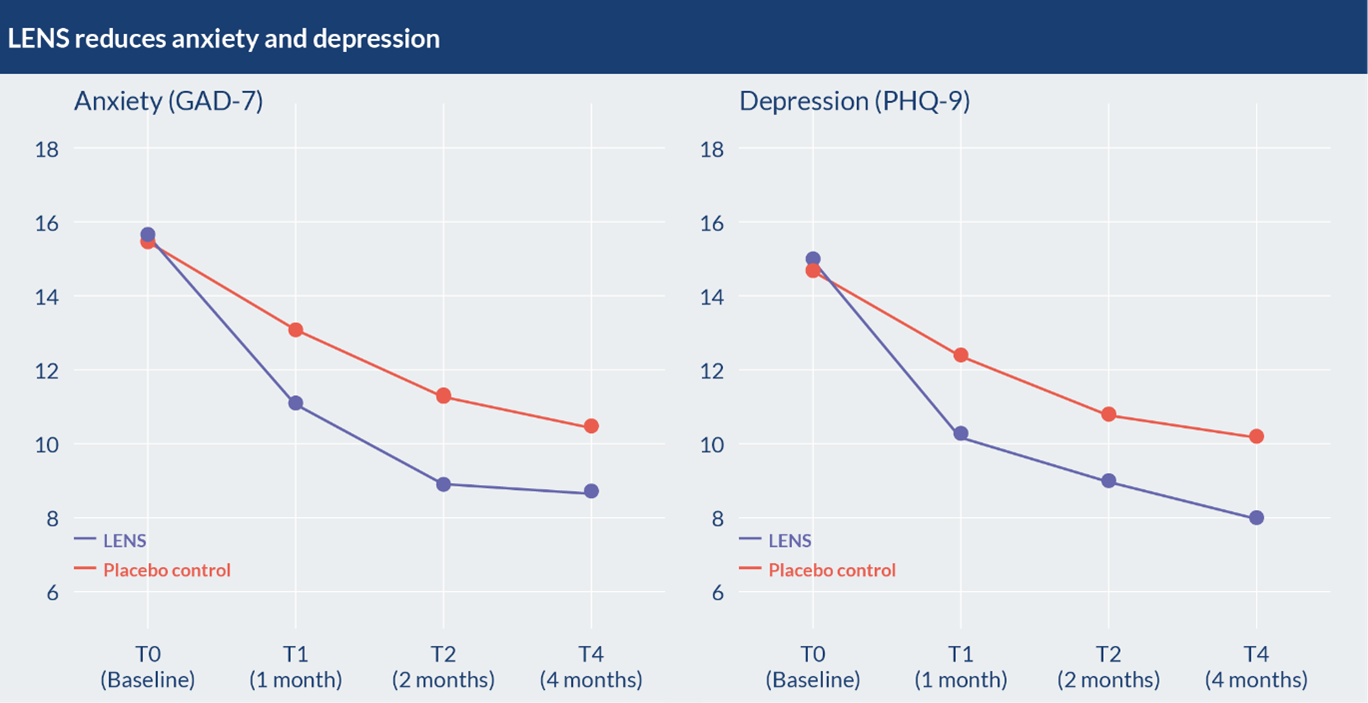
LENS reduces symptoms in the longer term, in those suffering from clinical anxiety and/or depression (Figure 1), as well as those at high risk for these disorders. LENS is the first form of interpretation training to lead to better outcomes than control conditions in reducing anxiety and depression; and targeting interpretation bias underlies these superior results.
Figure 1: LENS reduces symptoms in the longer term, in those suffering from clinical anxiety and/or depression.
Adapting LENS to specific groups
Feasibility studies of adaptations of LENS for people with long-term physical health conditions such as cancer and Parkinson’s disease who often experience anxiety, indicate that large scale trials could now be conducted.
LENS is a straight-forward, low-stress intervention and so easy to complete, even in stressful periods when the ability to implement more complex interventions such as cognitive behavioural therapy can be difficult. LENS could help people with depression and anxiety recover, and mental health services provide a low-intensity intervention, with wider dissemination via primary care services or mental health support groups.
Economic Benefits
Research conducted in February 2024 by Pro Bono Economics and funded by MQ Mental Health evaluated the potential benefits if LENS were made available to those who experience anxiety disorders in the general population, approximately 1.4 million people. The improvements to quality of life would be substantial, and could translate to as much as £2.9 billion in economic benefits.
RELAX Study for pregnant women
Anxiety disorders affect 1 in 5 pregnant women or birthing people. An NIHR Efficacy and Mechanism Evaluation grant supported adaptations for pregnant women with high levels of worry/rumination, putting them at risk of anxiety, to test LENS as a preventive treatment before and after birth. The RELAX (REducing Levels of AnXiety) study was launched in February 2022 to trial whether web-based training can help to reduce and prevent worry and anxiety in pregnant women and new mothers.
Delivered through the NIHR Biomedical Research Centre: Maudsley, the first large-scale clinical trial of RELAX demonstrated the real-world impact of this digital intervention. Published in JAMA Network Open, the study found that RELAX significantly reduced anxiety during pregnancy and after birth, while participants receiving usual care alone were almost six times more likely to experience worsening anxiety symptoms. The intervention also reduced depression and repetitive negative thinking, a key driver of anxiety.
Abi, a member of the Patient and Public Involvement Advisors Group, speaks about her experiences of how RELAX helped reduce her anxiety:
Participant, RELAX studyI found that’s had quite a big impact on me actually… I’m finding that I’m coping much better with the worries that I am having… So, for example, we went for our 20-week scan… I was actually quite excited about the scan. And previously, scans have been a real trigger for me.
Read about the RELAX Study's PPIE work
- Meet the members of the Patient and public advisory group for the RELAX study
- ‘I was a bit sceptical’: The RELAX study’s public involvement – what we’ve done and how it feels to be involved
- Read the RELAX Study’s report from December 2025: Diversity, relationships and community leaders – Public involvement tips and reflections from the RELAX (Reducing Levels of AnXiety in pregnancy and after birth) research project – RELAX-study-report-Final
Looking to the future
The findings provide strong evidence that accessible, self-guided digital therapies can help address a major gap in perinatal mental healthcare, supporting people before symptoms escalate and reducing pressure on overstretched services. Building on this NIHR-supported research, RELAX is now being developed into the LENS4Pregnancy app, with researchers, clinicians, policymakers and people with lived experience working together to support future implementation across NHS maternity services
Related links
- RELAX (Reducing Levels of Anxiety) Study – Project page on King’s College London website
- Scaling up LENS – a project supported by the One King’s Impact Fund
- Hirsch CRVolkmer BSawjani Y, et al. RELAX Perinatal Digital Intervention to Prevent Increasing Anxiety: A Randomized Clinical Trial. JAMA Netw Open. 2026;9(11):e2640518. doi:10.1001/jamanetworkopen.2026.4051