Vaccination reduced but did not eliminate mortality inequalities for people with severe mental illness
Informatics
Those with severe mental illness remained at significantly higher risk of death following COVID-19 infection throughout the pandemic, despite being prioritised for vaccination, according to a major new study published in The Lancet Psychiatry.
Researchers analysed health records from more than 13 million people in England who had COVID-19 between January 2020 and June 2023, making it the first study to use data from every primary care practice in England to examine mortality inequalities among people with severe mental illness (SMI) across the course of the pandemic.
The study was led by researchers from the Institute of Psychiatry, Psychology & Neuroscience (IoPPN) King’s College London and examined whether the heightened mortality risk previously identified among people with SMI reduced after COVID-19 vaccines became available. Earlier research from King’s found that people with severe mental illness were at greater risk of dying after SARS-CoV-2 infection, helping inform a decision to prioritise this group for vaccination in February 2021. The UK was one of only four European countries to adopt this approach.
The new findings suggest that while prioritisation initially improved vaccine uptake, substantial inequalities in mortality persisted.
The researchers identified 13.5 million people with COVID-19, including more than 160,000 people with a diagnosis of severe mental illness, such as schizophrenia, schizoaffective disorder, bipolar disorder or other psychotic disorders. The study was innovative through its use of data from all primary care practices across England during pandemic. The data was from the NHS England Secure Data Environment provided through the British Heart Foundation (BHF) Data Science Centre CVD-COVID-UK–COVID-IMPACT Consortium linked datasets.
Initial success in vaccination uptake
The study examined outcomes across three phases of the pandemic, spanning from the initial emergency period in 2020 through vaccine roll-out and the post-restriction phase up to June 2023.
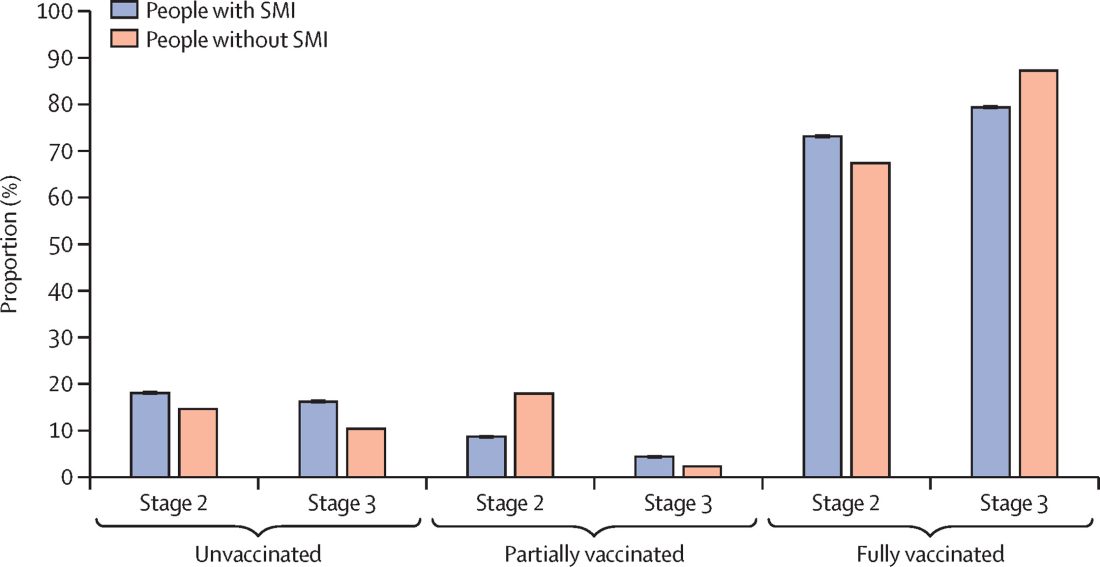
Researchers found evidence that prioritising people with SMI for vaccination helped increase uptake during the early stages of the programme. By July 2021, 73.2% of people with SMI had received two vaccine doses, compared with 67.4% of people without SMI.
However, this advantage did not continue over time. By June 2023, vaccination coverage among people with SMI had fallen behind the rest of the population. Just under four in five people with SMI (79.4%) were fully vaccinated, compared with 87.2% of people without SMI.
The authors say the findings suggest that while prioritisation was effective in supporting early uptake, longer-term support may be needed to sustain vaccination coverage among people with severe mental illness.
Figure 3 shows vaccination status for people with and without SMI, taken at two timepoints: at the end of the target vaccination roll-out (July 18, 2021; end of stage 2–beginning of stage 3; and June 30, 2023; end of follow-up stage 3. A slightly higher proportion of people with SMI were fully vaccinated against SARS-CoV-2 in July, 2021 (112 795 [73·2%, 95% CI 72·9–73·4]) compared with people without SMI (8 852 970 [67·4%, 67·3–67·4]). However, by the end of the follow-up period in 2023, a lower proportion of people with SMI were fully vaccinated against SARS-CoV-2 (127 145 [79·4%, 79·2–79·6]), compared with people without SMI (11 605 915 [87·2%, 87·2–87·3]).
Mortality inequalities persisted
Across the entire study period, people with SMI experienced a 56% higher risk of death from any cause following COVID-19 infection compared with people without SMI, even after accounting for factors such as age, sex, ethnicity, deprivation, physical health conditions, smoking and body mass index.
People with SMI were also more likely to die specifically from COVID-19. During the vaccine roll-out period, they experienced a 52% greater risk of COVID-19-related death than people without SMI. Even during the later stages of the pandemic, after researchers accounted for vaccination status, the risk remained 25% higher.
Vaccination appeared to reduce some of the additional risk, but it did not eliminate it entirely. This suggests that other factors, including physical health inequalities, barriers to healthcare access and wider social disadvantages, may continue to contribute to poorer outcomes among people with severe mental illness.
People with severe mental illness have long experienced some of the poorest physical health outcomes in society. Our study shows that these inequalities persisted during the COVID-19 pandemic, even after vaccines became available. Prioritising people with severe mental illness for vaccination was an important and effective policy, but more needs to be done to address the wider factors that contribute to poorer health and premature mortality in this population.
Professor Jayati Das-MunshiSenior author of the study and Professor of Social and Psychiatry Epidemiology at the IoPPN, King’s College London
Implications for future public health planning
The authors conclude that prioritising people with severe mental illness for vaccination was beneficial and helped drive early uptake during a public health emergency. However, they warn that vaccination alone is unlikely to address the longstanding mortality gap experienced by this population.
The researchers call for stronger preventive public health and clinical strategies, including outreach approaches that improve vaccine uptake and address the wider physical health needs of people with severe mental illness. Such measures could help reduce health inequalities in future pandemics and beyond.
The work was supported by the BHF Data Science Centre, Health Data Research UK, the ESRC Centre for Society and Mental Health, the NIHR Biomedical Research Centre: Maudsley, and the UKRI Population Mental Health Consortium.