
Soha Patil
Soha Patil is one of our PhD students. Her PhD is on translational neuroimaging for psychosis and mood disorders. She is supervised by Professor Matthew Kempton and Dr Ashwin Venkataraman.
In April 2026 Soha was asked about her academic journey, her PhD and her thoughts on diversity in research.
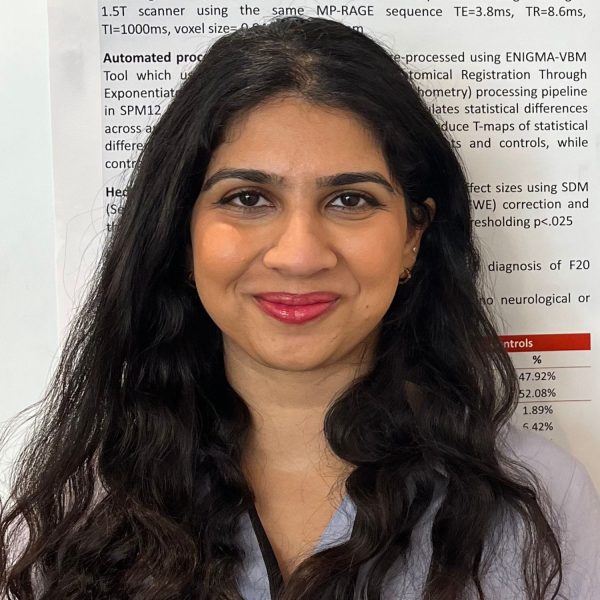
“I wanted to do a PhD to build a career that would shape the future of mental health research, making it inclusive to previously overlooked and underserved demographics.
Brain scans are useful to learn about different mental health conditions. Most brain scans in research settings have traditionally been done only on certain groups of people. People who were White European, less deprived, healthy and younger). This means when you want to find out the underlying causes of a mental health condition such as Psychosis, it may not be truly representative due to these biases of the people who had brain scans.
My PhD project is important to me. It aims to investigate a more representative population from across the South London and Maudsley NHS Trust. It looks at diverse ethnicities, multiple physical illnesses, and a range of deprivation to develop more representative brain maps for patients with psychosis and mood disorders.
The lack of diversity in research creates a greater divide between wellbeing of populations. I want to change this through my PhD, and in the future, through teaching.
My background is in Biomedical Engineering and I worked in healthcare previously. I wanted a deeper look into research so I pursued an MSc in Psychiatric Research at King’s College London and this helped solidify my aspirations for a PhD. I hope that my findings can clarify the need for including diverse populations in our research. Treatments are not one-size-fits-all, so we need research on diverse populations that are reflective of the world we live in today for treatments to be applicable to all.
Ultimately, after completing my PhD I would like to go into the healthcare industry working at companies that research women’s health.”